
progress
We've made it far—why stop now?
The water quality of the Androscoggin has continued to improve since the Clean Water Act passed in 1972. The State recently upgraded the Lower Androscoggin to a Class B river, an official water quality designation that affirms safety for swimming, fishing, unimpaired fish habitat, and public drinking water after treatment. As a result, the river now has the potential to offer diverse services to the communities along its banks.
While the river did not rebound overnight, the Clean Water Act has been a massive success. Today, sturgeon leap out of the water while herring swarm downstream of the dam. Kids swim in their river as their grandparents watch onshore, remembering their childhoods, when they were not even allowed to ride bikes nearby. Pollution is no longer the major impediment to watershed health it once was. Now dam management proves the biggest hurdle to further improvement.

Ineffective Ladder
Everyone agrees on this
All interested groups, including dam-owner Brookfield Renewable, acknowledge the current fish ladder does not work. The Maine Department of Marine Resources (MDMR) determined that the fish passage goal should be adequate to support a population of over 9 million fish. But the ten-year average of fish successfully climbing the Brunswick ladder has been only 82,000, or less than 1% of this goal. Some species, such as shad, are incapable of using this ladder at all. Most people would not be satisfied with a car running at 1% of performance specifications. But there are alternative solutions.
Free The Andro was formed to advocate for improved migratory fish passage. These species include alewives, American eels, American shad, Atlantic salmon, blueback herring, rainbow smelt, sea lamprey, and striped bass. We believe that allowing more fish to reach their historic spawning grounds will have ecological, economic, and community benefits for us all.

It is impossible for fish to pass the Brunswick Dam without human assistance. At the time of construction, the federal passage goals were limited by existing lower water quality and pollution. Annual averages through the ladder never met those limited goals.
Under today’s conditions, recent State estimates for fish potential up to Lewiston are considerably higher (almost 10 times total). However, the ladder in Brunswick passes 1% or less of that potential.
policy window
No time like the present
The next opportunity to influence the conditions for relicensing the dam could be as late as 2079.
Brookfield Renewable Partners, part of a trillion-dollar international conglomerate, operates the Brunswick Dam through a license from the Federal Energy Regulatory Commission (FERC). FERC issues licenses of 30–50-year terms. The Brunswick Dam was first licensed in 1979 and completed in 1982. Its first relicensing is slated for 2029, offering a once-in-50-year opportunity to improve migratory fish passage and other stakeholder management goals. It is worth noting that Brookfield is expected to pay for any engineering and management changes found necessary for relicensing to be approved.
The Federal Power Act designates FERC to manage the licensing of hydropower (16 U.S.C. § 791 et seq.). During the FERC process, the dam’s owner—Brookfield Renewable Partners—contracts scientists and engineers to explore fish passage options, working alongside regulators such as the National Oceanic and Atmospheric Agency (NOAA) and the Maine Department of Marine Resources (MDMR). Since FERC is a regulatory agency, there will be opportunities for public comment throughout the process.
While this process is mostly a federal one, the State of Maine will have limited power. Before a license is granted, the Maine Department of Environmental Protection must issue a water quality certification per § 401 of the Clean Water Act.
HEAD OF TIDE
Stopped at the gate
The Brunswick Dam is located at the head of tide, or the point furthest upstream where the river fluctuates due to tides. This location presents unique management challenges. The Brunswick Dam is the first obstacle fish face when coming from the ocean. Therefore, any upriver improvements in the next 50 years are moot unless fish passage is improved in Brunswick-Topsham.
Not only does the head of tide position raise the stakes of the relicensing process, but it also complicates the engineering of fish passage standards. Fish ladders struggle to attract species such as shad in the most stable conditions, but the tidal nature of the Lower Androscoggin means water levels are changing multiple times a day. This complicates the placement of fish ladder entrances and attraction flows, making most fish ladder designs poor options to achievesuccessful migratory fish passage.
Sources
diversified priorities
Rebalance the river
For over 50 years, ecological, economic, recreational, and community priorities have taken a back seat to hydropower. FTA believes it is time to rebalance river management strategies in a way that better serves the diverse interests of our community.
The Brunswick Dam’s current configuration blocks the connection between the river and the ocean. On average, fewer than 10 endangered Atlantic Salmon made it past the dam annually. Alewife and blueback herring, historically the foundation of ecosystems and saltwater commercial fisheries, are running at ~1% of potential migration. These fish are returning in large numbers, but they cannot get past the dam to reproduce upstream.
Improved river connectivity also has tremendous economic benefits, including increased fish catch, recreation, and tourism. A 2020 NOAA report predicted the economic benefits of improved fish passage on the Lower Androscoggin River will total $5.8–$14.8 million. This includes $1.7–$4.4 million of commercial fishing benefits and $4.0–$10.4 million of recreational fishing benefits.
These estimates are conservative, as they only include catch data from tidal waters, exclude increases from commercial lands of alewife, and use low biomass estimates. Additionally, the report was published in 2020, and the per-pound price of fish relied on 2017 data, so these values do not account for recent inflation. This report also did not quantify the nonuse value, or the value of a river as a public good to those who aren’t fisherman.
Sources

Some of the many benefits that could be prioritized to benefit and serve a much broader proportion of our community.
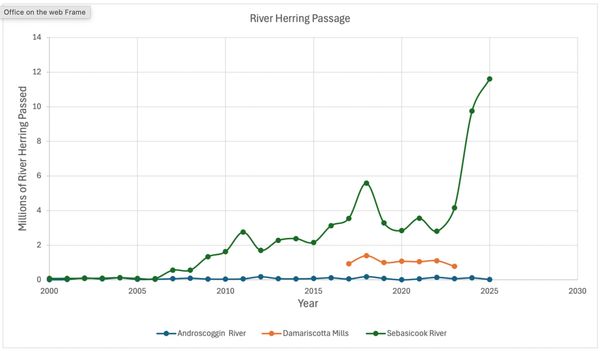
Herring migration counts from Benton Falls Dam on the Sebasticook (a tributary of the Kennebec River), Damariscotta Mills on the Damariscotta River, and the Brunswick Dam which limits all migration into the Androscoggin River watershed.

Comparison of size and total fish passage for Benton Falls Dam and Brunswick Dam, 2025. The Androscoggin River is up to 10 times larger than the Sebasticook River but 100 times fewer fish migrated through the Brunswick Dam ladder.
relicensing Options
An ongoing process
There are a range of engineering solutions under consideration to improve fish passage at the Brunswick Dam. Brookfield, the Federal Energy Regulatory Commission, other federal and state agencies, and community stakeholders are collecting relevant data and deliberating among these alternatives.
No changes – This option is unlikely as even the dam owner, Brookfield White Pine Hydro, acknowledges that the current ladder is ineffective.
Retrofit existing ladder - It is also unlikely that a retrofit of the existing ladder would result in adequate improvement. The original ladder has several flaws including an entrance that is too close to the turbine exit and incorrectly sized vertical slots between each step pool. These problems could not be solved with simple retrofits.
Improved fish ladder – A new ladder could be built in roughly the same location. However, fish ladders are poor choices for dams situated at the head of tide. Successful ladders are designed to produce optimal attracting flows to draw fish in. But a ladder entrance on a tidal river experiences four water level swings a day making it almost impossible to maintain optimal attracting flows. Besides the head of tide complications, fish ladders have a very narrow range of species that can pass in optimal conditions. Even with flawless design, some fish species are unable to use specific fish ladders. In some cases, multiple ladders with different specifications have had to be built on the same dam to accommodate several fish species.
Fish lift – This option is basically an elevator for fish, where fish swim into a bucket and are lifted above the dam. Elevators are more effective than ladders at attracting and moving a wide range of fish sizes and species. An excellent example of this can be found on the Sebasticook River (Benton Falls Dam). However, fish lifts require a dedicated operator to move the fish, and they are shut down outside of business hours (which fish don’t recognize). Another problem with fish lifts is that they are machines in water with many moving parts and can fail. This can result in dead fish in the lift bucket and long backups at the lift entrance delaying movement during the short migration period.
In-channel fishway – This alternative would divide the river to share it between hydropower and fish migration. The unusual topography above the Brunswick Dam includes a shallow ridge that runs from the dam roughly halfway up the riverbed for hundreds of feet. This makes it possible to split the river in half by building a relatively small wall (approx. 5-15 ft) perpendicular to the dam. As a result, flows from the river could be split, with half channeled to the smaller impoundment above the turbines and the other half flowing through a restored riverbed on the Topsham side of the river.
Dam removal – FTA is not actively advocating for dam removal, and it is not a scenario being studied in the license renewal process. However, there is a small possibility that the Federal Energy Regularory Commission could denythe renewal application if Brookfield is unable to meet its responsibilities as a steward of the river. An entirely new license application process would then start if any controlling party wanted to remove the dam.
Sources
add sources here